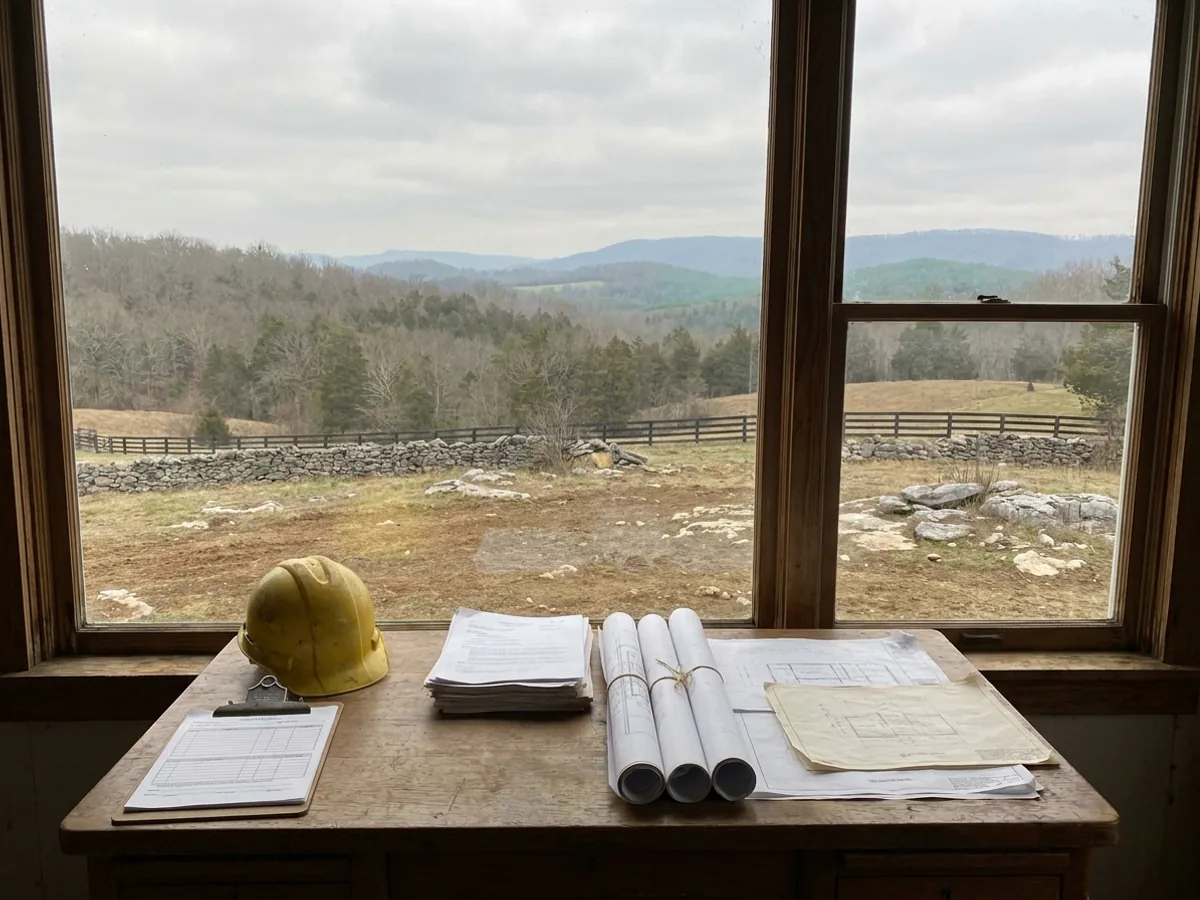
A building permit submittal package on a desk with rolled construction drawings, forms on a clipboard, and a hard hat.

Permitting & Engineering in Tennessee

These two go together because one is useless without the other: a Tennessee plan reviewer will not pass a clear-span building without a set sealed by a Tennessee-licensed engineer, and an engineered set is worth nothing until somebody carries it through review. We do both. Structural engineering against your jurisdiction’s adopted criteria, then the submittal, the comment cycles, and every inspection through to certificate of occupancy.

Permit-ready stamped drawings
Engineered to your county wind speed

How a permitting & engineering project runs

Four stages, in this order. The sequence matters more than it looks: getting engineering and permitting settled before anything is fabricated is what keeps a build from stalling.

1

Jurisdiction and zoning check

First we establish who actually has jurisdiction, the city or the county, and confirm your zoning allows a residence in this building type. Getting this backwards costs months.

2

Structural engineering

A Tennessee-licensed engineer analyses the frame against the design criteria your jurisdiction adopted, then seals the foundation, anchor bolt layout, framing and connection details. A seal from an engineer not licensed in Tennessee is rejected regardless of how sound the engineering is.

3

Assemble and submit

Sealed plans, energy calculations, wind-load documentation, truss engineering, product approvals, site plan, and the ancillary approvals like septic and driveway that reviewers ask for late.

4

Comments through to CO

We answer review comments quickly, then schedule and meet every inspection from footing to final, and close the permit out to a certificate of occupancy.
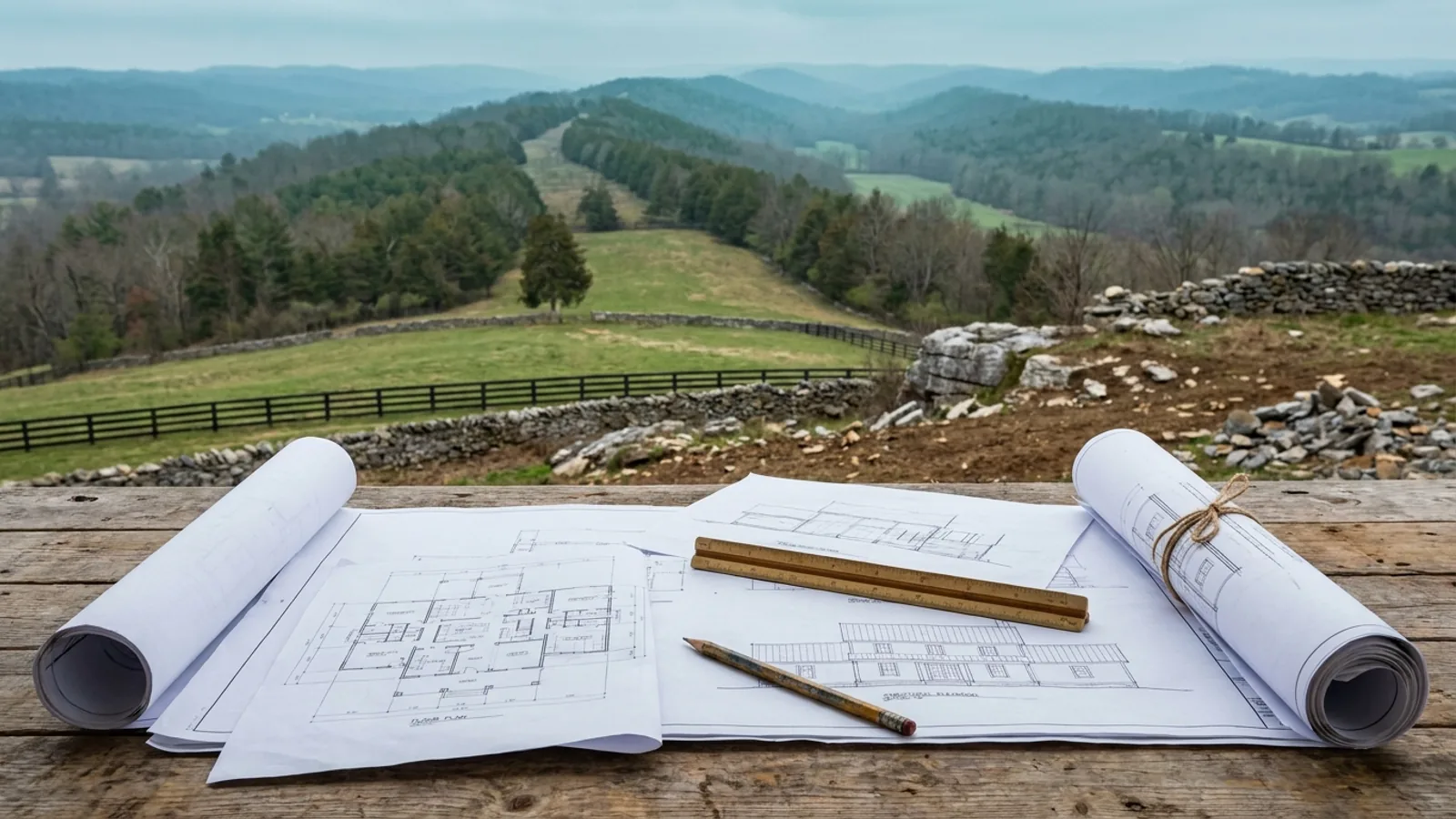
Overhead view of architectural floor plan and structural elevation drawings spread on a workbench with a scale ruler and pencil.
Where projects stall

In Tennessee, "do I need a permit" has three different answers

Every Tennessee jurisdiction sits in one of three states. Some have certified to the State Fire Marshal that they adopt and enforce their own codes, so you deal with a local department. Some have no local programme, so the State Fire Marshal issues the residential permit and inspects. And some have voted themselves out of the residential code entirely, by a two-thirds vote of the legislative body under T.C.A. 68-120-101(b)(1)(B)(i). The answer is genuinely different in each, and it is not a detail you can look up once for the whole state.

Where we deliver permitting & engineering

Grouped by county, because in Tennessee the county or the city sets your permitting authority, whether the residential code is enforced there at all, and the design criteria filled into Table R301.2. Two places twenty miles apart can carry very different engineering, and a county can vote itself out of the residential code while a city inside it stays in.

Blount County

Bradley County

Cumberland County

Davidson County

Hamilton County

Jefferson County

Knox County

Loudon County

Maury County

Montgomery County

Putnam County

Robertson County

Rutherford County

Sevier County

Shelby County

Sumner County

Washington County

Williamson County

Wilson County

Before you commit

What actually decides the price

Square footage is the number everyone leads with, and it is rarely the one that moves a barndominium budget. These four do.

  • Which of the three situations you are in

    A local department, the State Fire Marshal, or a jurisdiction with no residential enforcement at all. These are three different submittals with three different fee schedules, and the same drawings move through them at very different speeds.

  • Scope of the submittal

    A shell permit and a full residential permit with mechanical, electrical and plumbing are different submittals on different review paths. Note that Tennessee deleted the IRC electrical chapters and applies its own electrical standards instead, so that part is not reviewed against the IRC.

  • Engineering already in hand

    If the sealed structural package exists and is correct for the criteria your jurisdiction has adopted, permitting is administration. If it does not, permitting is engineering with a queue in front of it.

  • Review comment rounds

    Comments are normal. What costs time is a slow or incomplete response to them, which is the part we take off you.

A building permit submittal package on a desk with rolled construction drawings, forms on a clipboard, and a hard hat.

Permitting & Engineering in Tennessee: common questions

7 questions we get asked most often about building in Tennessee. If yours is not on the list, ask it directly.

How do I find out which of the three situations my parcel is in?
You check the jurisdiction, not the map. A local government becomes an enforcing jurisdiction by certifying in writing to the State Fire Marshal that it adopts and enforces its own codes, and a municipality can certify for any of three scopes: all buildings, all buildings other than one- and two-family dwellings, or one- and two-family dwellings only. That last distinction catches people. A city can have a real building department that reviews commercial work while leaving houses to the state. So the question to ask is not whether there is a building department, it is what its certification covers. Where there is no local programme and no opt-out, the State Fire Marshal issues the residential permit and inspects.
My county has voted itself out of the residential code. Do I still need a permit?
This is where Tennessee genuinely differs from most states, and the honest answer is no, not from the county. Under T.C.A. 68-120-101(b)(1)(B)(i) a county or municipality can exempt itself from the one- and two-family dwelling standards by a two-thirds vote of its legislative body, and in that jurisdiction the requirement is actually gone rather than merely unenforced. Two things qualify it. A county resolution reaches only the unincorporated area, because the statute limits county action to the boundaries outside any municipality in it, so a city inside an opt-out county decides for itself and may well require a permit. And you can still ask for an inspection: since 2017 an owner or contractor in an opted-out jurisdiction may obtain a state residential permit and request a State Fire Marshal inspection, on (615) 741-7170. Nobody makes you. A lender, an appraiser or an insurer often makes it worth doing anyway, and it is far cheaper to have that record than to reconstruct it at resale.
Is an opt-out permanent?
No, and this is the part almost everyone gets wrong. Under T.C.A. 68-120-101(b)(1)(B)(ii) an exempting resolution expires 180 days after the next election for that local legislative body, unless it names an earlier date. It has to be re-passed to stay in force. So a jurisdiction status has a date attached to it, and a forum post, an old article or a neighbour who built five years ago is not evidence of what is true today. We confirm the current status with the jurisdiction and with the state before we draw anything, and you should treat any answer without a date on it as unverified.
Can I just permit it as a farm building?
No, and the statute does the work in one word. T.C.A. 68-120-101(c) lists what the statewide standards do not apply to, and item (2) is "nonresidential farm buildings". The exemption is written for a building nobody lives in. The moment the structure contains a dwelling unit it is a one- or two-family dwelling and the exemption is gone, whatever the zoning is, whatever the tax treatment is, and however much it looks like a barn from the road. The other exemptions in that subsection are equally specific: renovations of existing one- and two-family dwellings, temporary buildings used exclusively for construction purposes, structures regulated under Title 68 chapter 126, and buildings reviewed by the board for licensing health care facilities. None of them describes a new barndominium.
Which code edition will my plans be reviewed against?
The 2018 International Residential Code with Tennessee amendments, effective 16 July 2020, is the statewide minimum. Several jurisdictions enforce a newer edition. That is worth stating plainly because Tennessee runs a split: commercial work moved to 2021-edition codes in April 2025 while one- and two-family dwellings stayed on the 2018 IRC. National articles and out-of-state plan sets routinely describe a residential code Tennessee has not adopted, and the section numbers move between editions. In the 2018 edition Tennessee sets as its statewide minimum, R310 is emergency escape and rescue openings, R318 is protection against subterranean termites, R313 is automatic fire sprinklers and R314 is smoke alarms. Those numbers hold in the 2021 edition too, but the 2024 edition renumbers that chapter, so in a jurisdiction that has adopted it the same numbers point at different subjects. Check which edition your county or city enforces before quoting a section to anyone. A comment letter citing the wrong edition is a slow way to find that out.
Do I need a contractor licence to build my own barndominium?
That depends on a number rather than on a rule of thumb, and it is worth knowing before you start. Tennessee requires a contractor licence for projects of $25,000 or more, and it counts the complete project cost including labour and materials. Splitting the work into separate phases, purchase orders or contracts to stay under the threshold does not work and is specifically anticipated. The residential classification is BC-A; the restricted residential classification BC-A/r is capped at $125,000. A property owner may build on their own property for their own personal use, which is the exemption most self-builders are relying on, and it does not extend to commercial construction. The Board for Licensing Contractors at the Department of Commerce and Insurance administers all of it, and they will answer the question about your specific project faster than a forum will.
What engineering comes with the permit package?
A sealed structural set for your parcel: foundation and anchor bolt layout, primary and secondary framing, connection details, and the design criteria called out explicitly. That last item is not boilerplate in Tennessee. Table R301.2 is a fill-in table here, with the ground snow load, design wind speed, seismic design category, frost line depth and termite classification supplied by the jurisdiction rather than by the state, so the criteria have to come from the table your building official has actually adopted. The reason the whole set exists is R301.1.3: a clear-span frame exceeds the prescriptive limits of Section R301, so its elements must be designed in accordance with accepted engineering practice. One local check worth making early is sprinklers. R313 is not mandatory statewide, but a local government may adopt more stringent requirements, so never assume from the state position alone.

Ready to put permitting & engineering against a real plan? Start there and the rest follows.

Tell us about the land

Send the parcel ID or an address and we will come back with what can be built on it, the wind load it has to meet, and a realistic budget range. That conversation costs nothing.