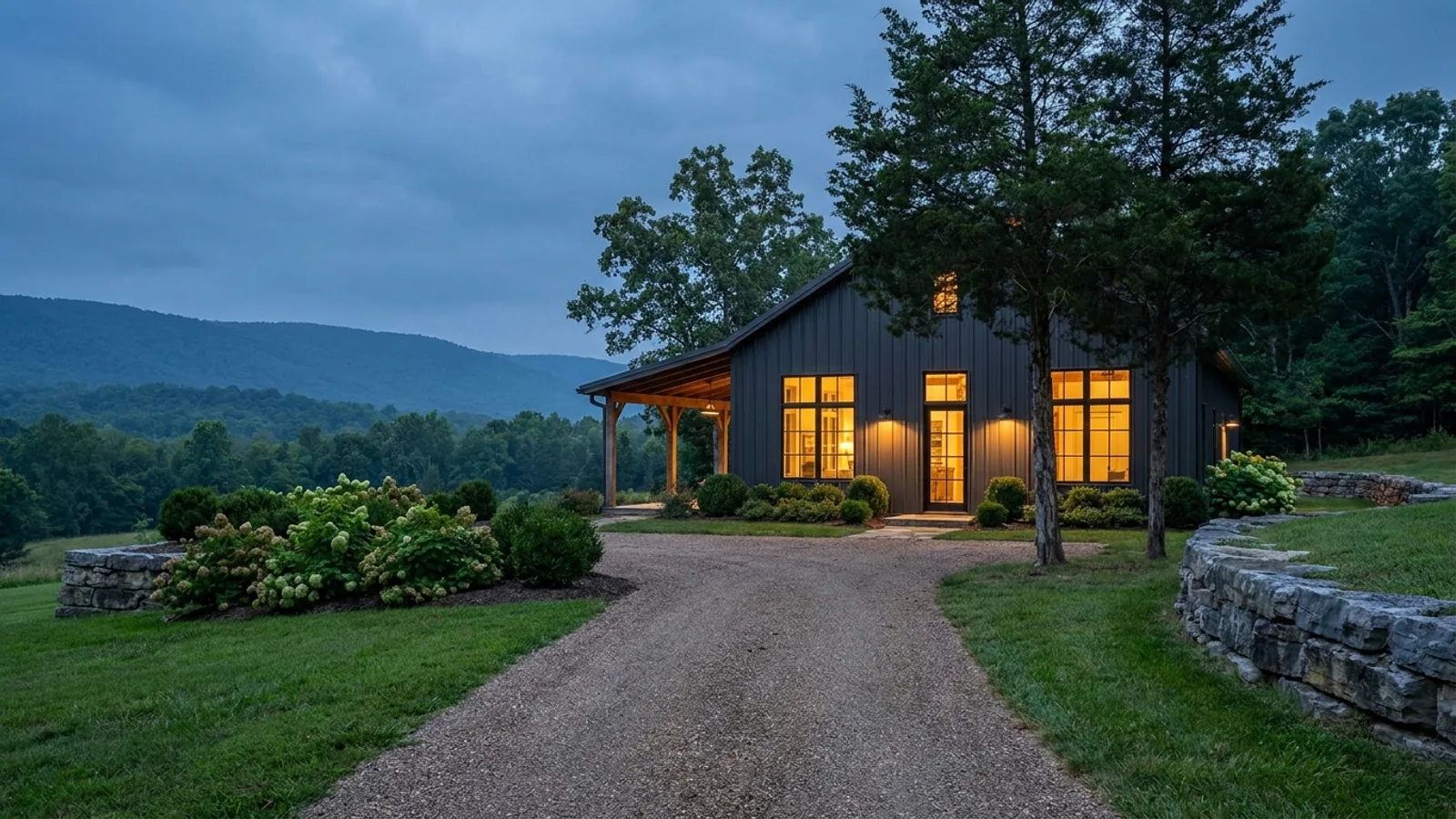
Barndominium Builders in Wilson County, TN
Wilson County is one of the fastest-growing counties in the Nashville ring and still 83% unincorporated, which is where the acreage is. The county runs its own Building Codes Department out of the Courthouse Annex in Lebanon and enforces the 2021 IRC, a newer edition than either Lebanon or Mt. Juliet, which permit land inside their own city limits under the 2018 IRC. In the A-1 Agricultural district a single-family dwelling is permitted by right on 80,000 square feet, and the ordinance sets no minimum floor area for the house at all.
Wilson County at a glance
- County
- Wilson County
- Population
- 175,033
- ZIP codes
- 37087, 37090, 37122, 37184, 37071, 37136
- Site visits
- About 45 miles east of our Franklin base, straight across on I-840 to Lebanon and Mt. Juliet
Building conditions in Wilson County
What actually changes from one Tennessee jurisdiction to the next: who issues the permit, whether the residential code is enforced there at all, what the structure has to be engineered to, and what the ground is like. These are the numbers your drawings have to satisfy.
Tennessee State Fire Marshal's Office, Residential Jurisdictions and Inspectors, stamped accurate as of 21 August 2026, and Wilson County Building Codes Division, wilsoncountytn.gov, both fetched 31 Aug 2026
Wilson County Building Codes Division adopted codes list, City of Lebanon Building Inspection Guidelines, and City of Mt. Juliet Building and Codes Department adopted codes, all fetched 31 Aug 2026
Wilson County Building Codes Division documents and the Wilson County Zoning Ordinance, last revision 21 July 2026, searched in full, fetched 31 Aug 2026
Wilson County Zoning Ordinance Sections 5.20.02, 5.20.05 and 5.10.05, last revision 21 July 2026, fetched 31 Aug 2026
Wilson County Zoning Ordinance Section 3.12.04, Foundation Requirements for Residential Structures, Resolution 05-7-2, last revision 21 July 2026, fetched 31 Aug 2026
Wilson County Residential Building Permit Fee Schedule, the Home, Addition and SDU Building Permit Application Checklist 2026, and the Building Inspector and Codes FAQ, wilsoncountytn.gov, fetched 31 Aug 2026
Also worth knowing before you build in Wilson County
- No minimum house size
- Wilson County sets no minimum heated floor area for a house in A-1 or R-1. The only dwelling square-footage limits in the ordinance run the other way and apply to secondary units: a detached accessory dwelling unit is capped at 1,000 square feet of total heated area and internal accessory quarters at 600, one of each per property, both on a permanent foundation meeting Section 3.12.04.
- Metal cladding on a house
- Wilson County's restriction on metal siding sits in Section 3.55, headed Site Development and Landscaping Standards, Commercial and Industrial Zone Districts. Its two subsections apply within commercial zone districts and within industrial zone districts respectively. Neither reaches A-1, A-2 or R-1, and neither reaches a dwelling, so there is no metal-cladding restriction on a house in the unincorporated county.
- Detached shops: height and matching
- An accessory building on accessory setbacks is capped at 22 ft in height. On principal setbacks it can go to 30 ft. On accessory setbacks it may still reach 30 ft, but only if it matches the predominant two roof pitch angles and the building material of the house. Accessory buildings also have to stand at least 8 ft wall to wall from any other structure and cannot cover more than 20% of the rear yard.
- Post-frame is a recognised foundation here
- The county's own inspection document defines the foundation inspection as covering, among other things, footings, monolithic slabs and post holes. Footings take a minimum of two runs of #4 rebar with 3 inches of cover at the bottom and in the corner, anchor bolts start between 3.5 and 12 inches from a corner and repeat at 6 ft centres, and any block or basement wall over 10 ft has to be engineered with documentation.
- Septic and electrical are not the county
- The county states plainly that its codes and zoning department does not permit or conduct electrical, septic, step or stormwater inspections. Septic is the Tennessee Department of Environment and Conservation field office on 931-520-6688. Electrical is the State of Tennessee Electrical Office for Wilson County, based in the City of Lebanon Public Works building at 410 Park Drive, and a passed state electrical rough-in has to be on file before the county will do the framing inspection.
- Two deadlines worth knowing
- A residential building permit cannot run longer than 24 months without a certificate of occupancy, and going past that needs relief from the Board of Zoning Appeals. Inspectors have 72 business hours to attend once an inspection is requested. A failed setback inspection costs $75, and re-inspections run $75, then $150, then $300 with a stop-work order.
- Five acres changes the paperwork
- A surveyed plot plan is not required for a tract above 5 acres, and the setback inspection is only triggered where the lot is under 5 acres and no stamped surveyed plot plan came in with the application. A detailed plot plan is still required on every permit whatever the tract size, and inspections are failed where the plot plan and the site do not agree.
- A barn is exempt from the height limit until someone lives in it
- The zoning ordinance exempts agricultural buildings, including a barn and a silo, from the district height limits, so long as the height does not exceed the distance to the property lines. The exemption is written as agricultural buildings but not including dwellings. It is the same line the state statute draws when it exempts nonresidential farm buildings from the statewide standards, and it closes the moment the building contains somewhere to live.
- Where the land is
- 83% of Wilson County's land is unincorporated, and agricultural and open-space land is still about 74% of the county across more than 56,000 platted parcels. Pasture and grassland alone account for roughly 133,100 acres. Between 2001 and 2016 the county lost about 11,270 acres of farmland, 15% of all farmland loss in Middle Tennessee over that period, and the county projects a further 22,600 to 50,100 acres of loss by 2040.
- Growth
- Wilson County grew 66% between 2000 and 2020, from 88,809 to 147,737 residents, and stood at 175,033 as of 1 July 2025. It is the tenth most populous county in Tennessee and its own land use plan projects it will be ninth by 2045 at around 257,000. Mt. Juliet grew nearly 218% between 2000 and 2020 and Lebanon almost 90%, but since 2020 Lebanon has grown faster, and the county expects growth outside the municipal boundaries to accelerate.
- Limestone, sinkholes and karst
- About 65% of the county sits in the Inner Nashville Basin and the rest in the Outer Nashville Basin, on limestone-rich soils. The county's land use plan maps sinkholes, karst geology, steep slopes and flood hazard as its environmental constraints, and its rural agriculture place type names constrained lands of slopes and karst directly. Land is generally gentle, at 500 to 600 ft, with slopes over 15% limited mostly to the Cumberland River corridor and the south-east.
- What a house costs to buy here instead
- The county's own land use plan reports that in 2024 the typical single-family home in Wilson County was valued at approximately $483,000 according to Zillow, needing an estimated household income of $123,700 to afford, against a countywide median household income of about $94,000. Homeownership in the unincorporated area runs at 89% of households.
Wilson County Zoning Ordinance Section 5.20.02, accessory dwelling provisions revised by resolution 20-10-20, last revision 21 July 2026, fetched 31 Aug 2026
Wilson County Zoning Ordinance Section 3.55.02 Building Material, Resolution 04-12-17, last revision 21 July 2026, fetched 31 Aug 2026
Wilson County Zoning Ordinance Sections 5.20.05 and 5.20.06 for A-1 and 5.10.05 and 5.10.06 for R-1, last revision 21 July 2026, and Wilson County Board of Zoning Appeals agenda of 17 July 2025, cases 4304 and 4308, fetched 31 Aug 2026
Wilson County Building Codes Department, Inspection Information for Commercial and Residential and Inspection Information for Homes and Additions, wilsoncountytn.gov, fetched 31 Aug 2026
Wilson County Building Codes Division, Electrical / Septic / Step / Stormwater page, and the Home, Addition and SDU Building Permit Application Checklist 2026, wilsoncountytn.gov, fetched 31 Aug 2026
Wilson County Building Inspector and Codes FAQ and the Residential and Commercial Inspection List, wilsoncountytn.gov, fetched 31 Aug 2026
Wilson County Development Services memo, Accurate Building Plan and Property Information, effective 1 October 2018, and the Residential and Commercial Inspection List, wilsoncountytn.gov, fetched 31 Aug 2026
Wilson County Zoning Ordinance Section 3.20.02 B, height exceptions, last revision 21 July 2026, fetched 31 Aug 2026
Plan Wilson, Wilson County Master Land Use Plan 2045 Horizon, approved 17 June 2026, wilsoncountytn.gov, fetched 31 Aug 2026
Plan Wilson, Wilson County Master Land Use Plan 2045 Horizon, approved 17 June 2026, citing US Census Bureau estimates, fetched 31 Aug 2026
Plan Wilson, Wilson County Master Land Use Plan 2045 Horizon, environmental and natural resources section, approved 17 June 2026, fetched 31 Aug 2026
Plan Wilson, Wilson County Master Land Use Plan 2045 Horizon, housing section, citing Zillow 2024 values, approved 17 June 2026, fetched 31 Aug 2026
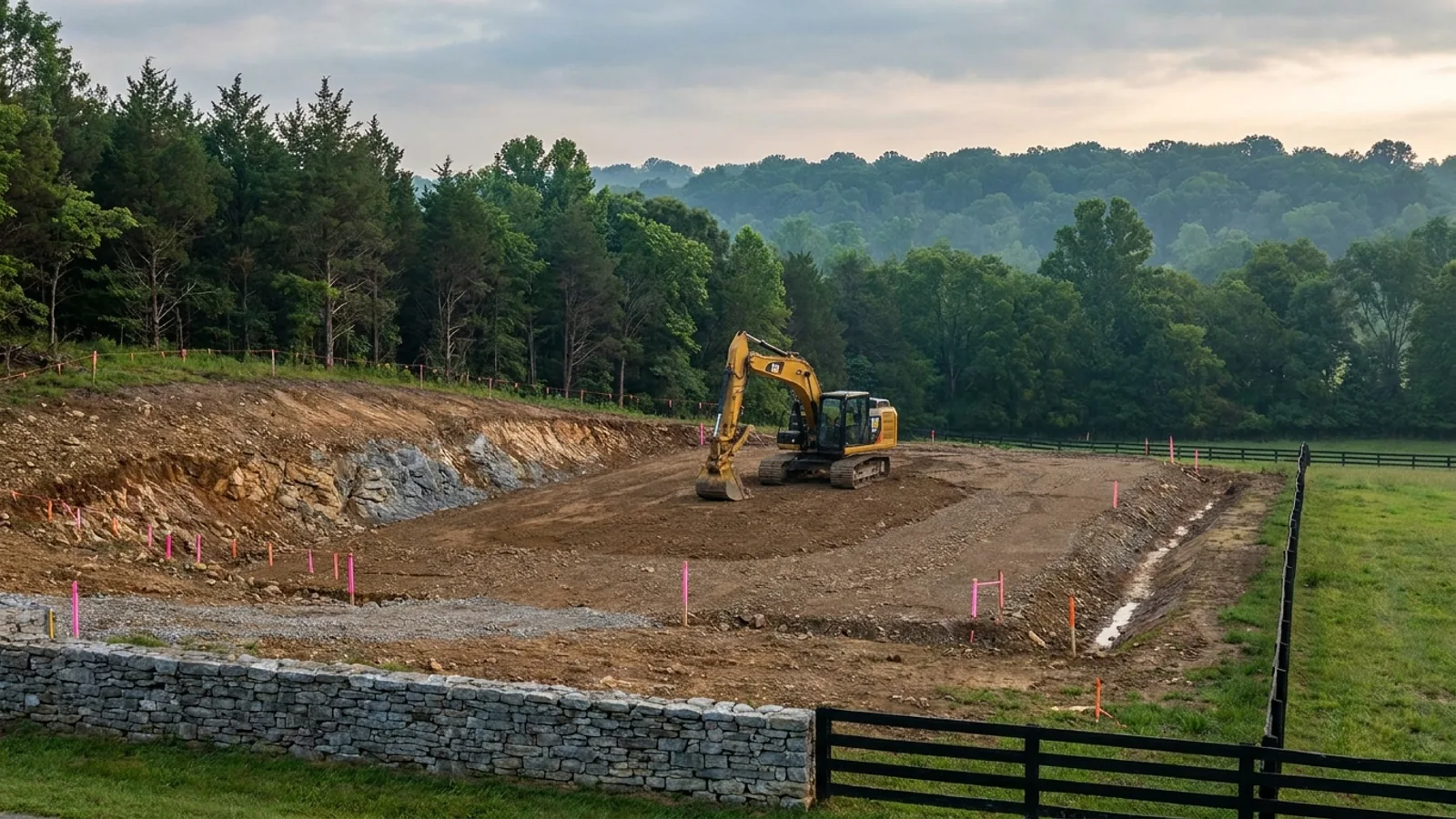
The expensive surprises are in the ground, not the building
What moves a Tennessee budget is usually below grade: limestone sitting shallow, karst voids and sinkholes, and slope. Those are the same conditions that decide whether a septic field passes its soil and site evaluation, so the grading plan, the footing depth and the drainfield get resolved together rather than one at a time. We price the dirt before we price the building.
What we build in Wilson County
All nine services are available across Wilson County. What a build costs depends far more on the parcel than on square footage, so we price against your land rather than publishing a rate card.
Barndominium Kits
Engineered barndominium shell packages delivered to your Tennessee lot, stamped for the criteria your county adopted.
Turnkey Builds
Start to finish barndominium construction: we handle permits, slab, shell, and full interior finish.
Custom Plans
Barndominium floor plans drawn to your land, your family, and the residential code your county actually enforces.
Post-Frame Homes
Pole barn construction adapted into full residences, with wide clear spans and fast dry-in.
Steel Construction
Red-iron and light-gauge steel framing: no rot, no termites, engineered to your county’s adopted wind criteria.
Shouses
Shop and house in one building: workspace and living space under a single roof and a single permit.
Metal Homes
Full metal-clad residences: low maintenance envelopes specified to your Tennessee climate zone.
Site Preparation
Clearing, grading, pad, drainage, and utilities: the work that decides whether the build goes smoothly.
Permitting & Engineering
Sealed structural engineering and the permit that depends on it, from submittal through final inspection.
What a build looks like
Three stages every Wilson County project passes through, from a raw parcel to a finished home. Site work first, because that is where the budget is decided.
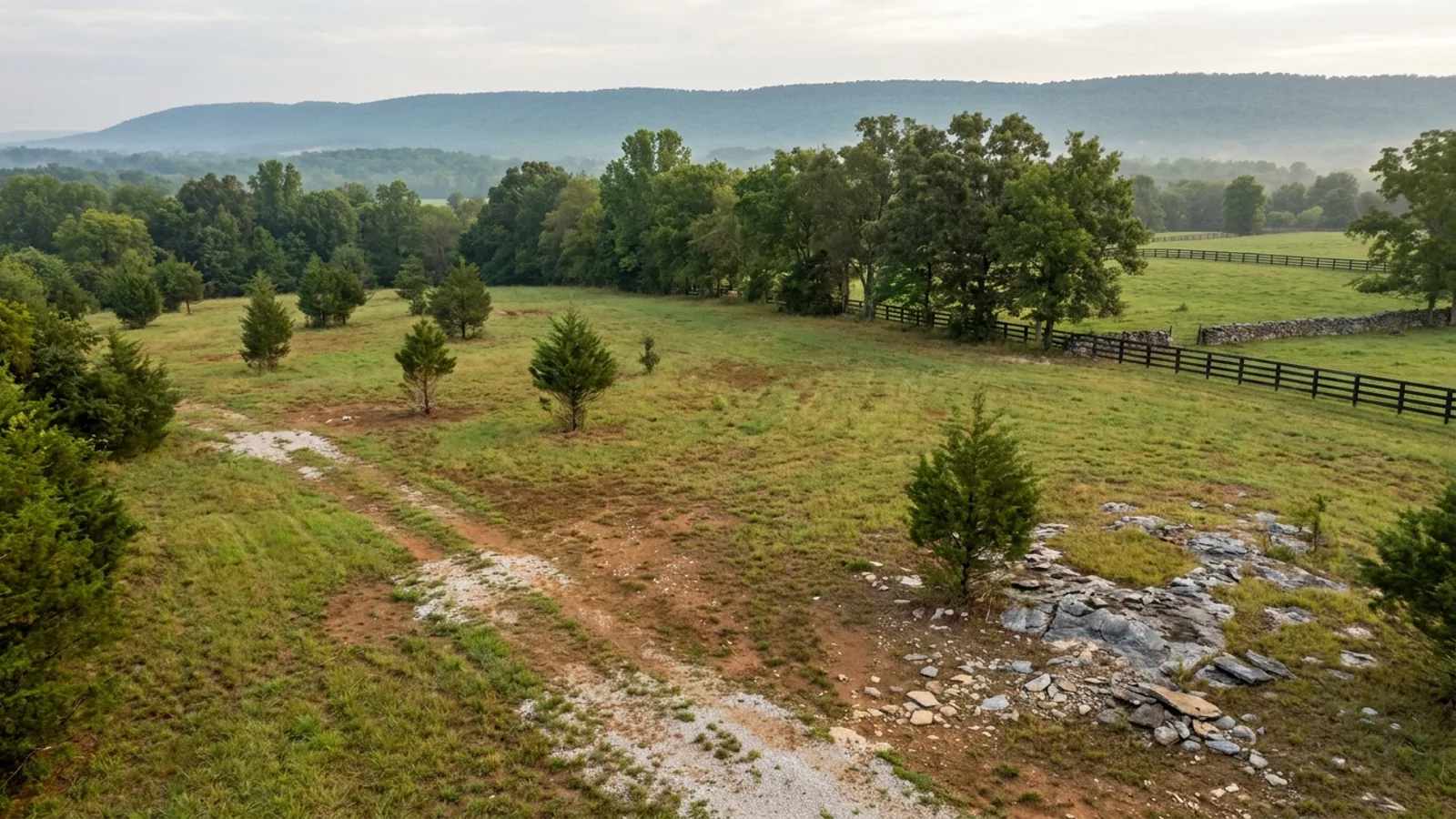
The parcel
Zoning, setbacks, flood zone and utility access get checked before anything is drawn.
Pad and permit
Clearing, grading and a compacted pad, while the submittal works through Wilson County.
Frame to finish
Shell erected and dried in, then systems, insulation and interior finish through to CO.
Those are the rules for Wilson County. Tell us what you want to build and we will draw it to them.
Where we build around Wilson County
Wilson County and the rural land around it. The buildable acreage for a project this size usually sits outside the city limits, which is frequently what changes who issues your permit.
Keep reading
The questions that usually come next once you know what Wilson County allows.
Barndominium Cost Guide
Sourced per-square-foot ranges by tier and by size, with a calculator built on the same figures.
Read itIs It Legal in Tennessee?
Classification, zoning, the HOA gate, and why "nonresidential farm building" does not cover a home.
Read itHow Long Does It Take?
Census build-duration data, and what actually sets the permit clock where you are building.
Read itSources for this page
The primary documents behind the Wilson County figures above. We would rather you checked them than took our word for it.
- Building Codes DivisionThe unincorporated county enforces the 2021 IRC — newer than either city.wilsoncountytn.gov
- Zoning DivisionDistricts, lot sizes and the county zoning ordinance.wilsoncountytn.gov
- Electrical / Septic / Step / StormwaterWho to call for each — septic here is TDEC, not the county.wilsoncountytn.gov
- Building Codes Department, Mount JulietA separate authority on an older edition than the county.mtjuliet-tn.gov
- Guidelines, City of LebanonLebanon permits inside its own limits.lebanontn.org
- Residential Jurisdictions & InspectorsThe State Fire Marshal’s own table of every Tennessee county and municipality, with its enforcement status. Stamped accurate as of 21 August 2026.tn.gov
Nearby areas we build in
Others we cover in this part of Tennessee. The permitting authority, the adopted design criteria and the zoning can all differ from one to the next.
Building in Wilson County: common questions
6 questions we get asked most often about building in Wilson County. If yours is not on the list, ask it directly.
Can I build a barndominium in unincorporated Wilson County, and what zoning do I need?
Does the county issue the permit, or does Lebanon or Mt. Juliet?
Will the county make me put brick or stone round the bottom of the building?
Can I clad the house in metal in Wilson County?
How much land do I really need, and who handles the septic?
How long do I have to finish, and can I live in the shop while I build?
What clients say
We had ten acres outside town and no idea what we could legally put on it. They pulled the zoning and the A-1 lot minimum before we spent anything on drawings, which saved us from buying plans for a building that would not have been approved.
Ordered the shell kit and erected it with my brother-in-law over about six weekends. The drawings were clear, the bolt schedule matched what showed up on the truck, and the county inspector had no issues with the engineering.
Turnkey from a cleared lot to certificate of occupancy. What I appreciated most was that when plan review came back with comments, I heard about it the same day along with what they were doing about it.
Building in Wilson County?
Start with the plan. Tell us what you want to build and we will draw it, then confirm what Wilson County will actually let you put on the parcel and what wind load it has to meet. That conversation costs nothing.