Barndominium Builders in Williamson County, TN
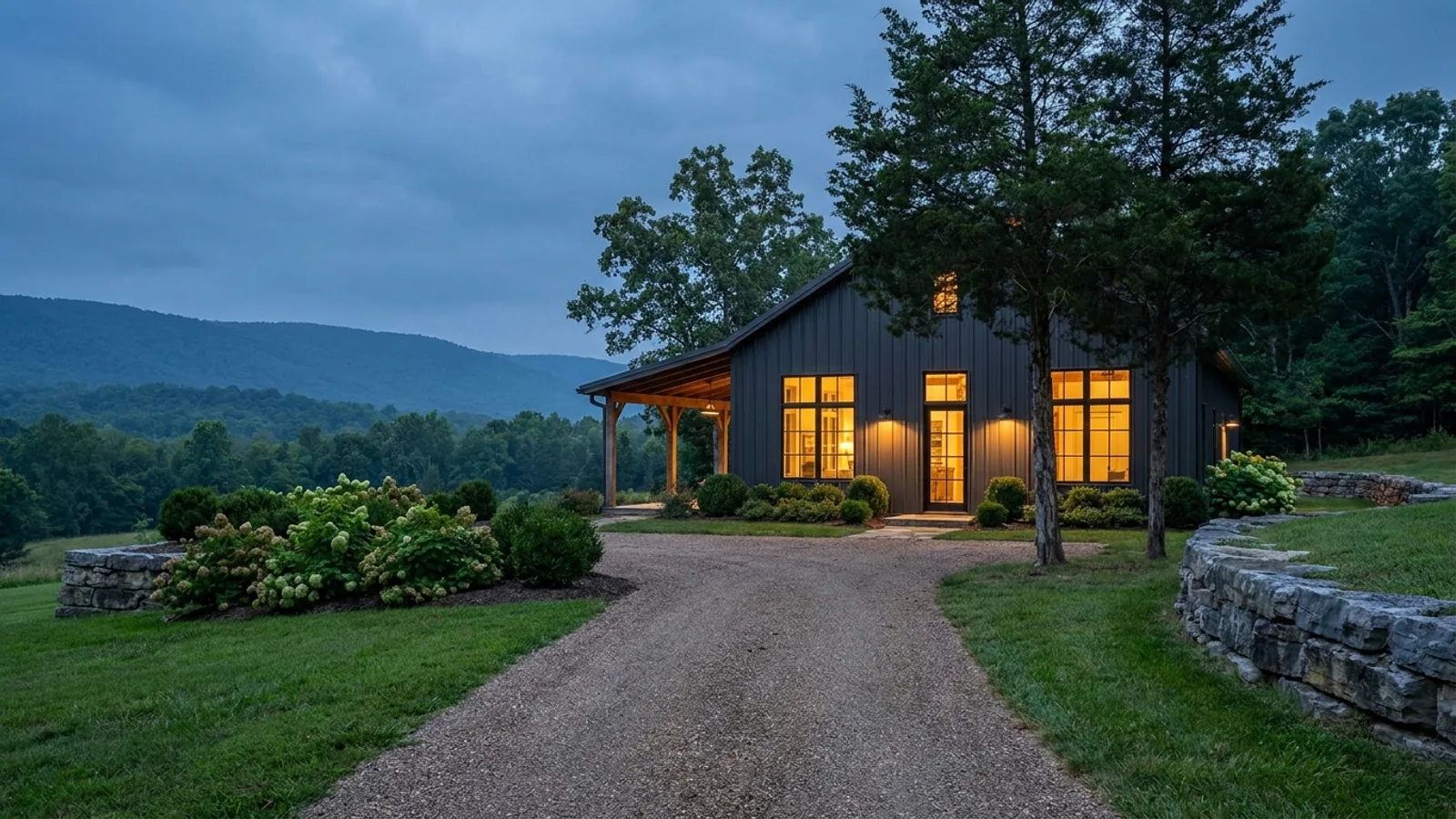
Williamson County is the wealthiest county in Tennessee and the one most people assume is hostile to a metal-clad house. Its zoning ordinance restricts exterior metal siding in exactly one place, the use-specific standards for craft distilleries, and sets no minimum floor area, no roof pitch and no height cap on a dwelling in its rural districts. The real constraints are land and money: RP-5 west of I-65 and RD-5 east of it both take a single-family house by right, on five acres, behind a hundred-foot front setback.
Williamson County at a glance
- County
- Williamson County
- Population
- 272,061
- ZIP codes
- 37069, 37064, 37067, 37027, 37135, 37179, 37046, 37014, 37062, 37174
- Site visits
- Our office is on Fieldstone Parkway in Franklin, a few minutes from the county Building Codes Division on West Main Street
Building conditions in Williamson County
What actually changes from one Tennessee jurisdiction to the next: who issues the permit, whether the residential code is enforced there at all, what the structure has to be engineered to, and what the ground is like. These are the numbers your drawings have to satisfy.
Williamson County Building Codes, williamsoncounty-tn.gov/100/Building-Codes, fetched 31 Aug 2026
Tennessee State Fire Marshal's Office, Residential Jurisdictions & Inspectors, accurate as of 21 Aug 2026, tn.gov, fetched 31 Aug 2026
Williamson County Adopted Codes, williamsoncounty-tn.gov/104/Adopted-Codes, fetched 31 Aug 2026
Williamson County Zoning Ordinance, adopted 14 May 2012, revision dated 10 June 2025, Article 11 Section 11.03(A)(10), fetched 31 Aug 2026
Williamson County Zoning Ordinance Tables 10.02-2 and 10.02-3 and Table 11.01-1, revision dated 10 June 2025, fetched 31 Aug 2026
Williamson County Sewage Disposal, williamsoncounty-tn.gov/126/Sewage-Disposal, and the county Schedule of Application Fees, fetched 31 Aug 2026
Also worth knowing before you build in Williamson County
- Where roof pitch rules do apply
- Minimum roof pitch appears in four places in the ordinance, all inside special-area-plan districts and several tied to a named road. Grassland Village Character 2 requires 7:12 along Old Hillsboro Road and 5:12 along Hillsboro Road, with gabled or hipped roofs and a one-foot minimum eave overhang. Character 3 requires 7:12. Character 4 and the Triune Character Areas require 5:12 facing state highways and 7:12 facing everything else. None of these reach RP-5 or RD-5 land.
- No minimum house size
- The Williamson County Zoning Ordinance sets no minimum heated floor area for a dwelling in any district. Its only reference to habitable floor area is in the definitions, which defer to the building code and exclude cellars. For a county with a median owner-occupied home value of $751,900, that is a more permissive position than most buyers expect.
- Attach the shop and the setback changes
- Section 11.04(3) of the zoning ordinance treats an accessory structure within 10 feet of the house as part of the principal structure, and does the same for one within 20 feet that is connected by a roofline. Run a shop bay under one continuous roof with the living space and the whole building has to clear the 100 ft front setback, not an accessory setback. That is worth knowing before the site plan is drawn.
- What the county charges
- The building permit fee is $1,660 for the first $500,000 of valuation plus $2.00 per additional thousand, with a plan-checking fee of half the permit fee on top. Fees are doubled if work starts before the permit issues. Add a $2.00 per square foot residential privilege tax, a $150 storm water fee on a residential lot, and $50 per re-inspection. The Zoning Certificate that has to come first is free.
- Education Impact Fee by house size
- Outside the Franklin Special School District, which is where unincorporated county land sits, the fee runs $3,374 for 1,399 sq ft or less, $6,018 to 1,899 sq ft, $8,033 to 2,399 sq ft, $9,679 to 2,899 sq ft, $11,046 to 3,399 sq ft and $12,237 at 3,400 sq ft or more. Inside the Franklin Special School District the same bands run $1,103 to $4,506. The schedule was revised on a TischlerBise study and took effect 1 March 2020.
- Inspections on a house here
- Ten inspections: footings, foundation, slab, slab plumbing where it applies, framing, mechanical, plumbing, insulation, storm water, and the final building inspection that releases the certificate of occupancy. Plans are submitted and inspections booked through the county's electronic plan review system. The county states that plans need not be drawn by a registered design professional unless the complexity of the project warrants it.
- Climate zone and envelope
- Williamson County is IECC climate zone 4A. Only fourteen West Tennessee counties sit in zone 3A; everything else in the state, this county included, is 4A. The county enforces the 2018 energy code with the 2009 tables, so the insulation, fenestration and duct-testing requirements are looser than a current national source will describe.
- Growth and building activity
- 272,061 residents as of the July 2025 estimate, up 9.8% since the 2020 census and up from 183,182 in 2010, across 582.86 square miles. The county recorded 1,621 building permits in 2025 against 103,674 housing units. Median household income is $135,594 and the median value of an owner-occupied home is $751,900.
- Seven authorities share one county
- The Williamson County growth plan, drawn under Tennessee Code Annotated Title 6, Chapter 58, Part 1, maps urban growth boundaries, planned growth areas and rural areas across seven jurisdictions: Brentwood, Fairview, Franklin, Nolensville, Spring Hill, Thompson's Station and the unincorporated county. The final plan was recorded on 3 January 2025. The zoning ordinance even sets a default for de-annexed land, designating it RP-5 if it lies west of I-65 and RD-5 if east.
- Accessory dwelling limits
- One accessory dwelling unit per parcel, whatever the number of principal dwellings. It is capped at 750 sq ft or 25% of the principal dwelling, whichever is greater, and can never exceed 75% of it. A deed restriction has to be recorded with the Register of Deeds before the zoning certificate and building permit issue, and an interior apartment must keep the exterior reading as a single-family home, with no second front door.
Williamson County Zoning Ordinance Article 10 Section 10.02, Grassland Village and Triune character districts, revision dated 10 June 2025, fetched 31 Aug 2026
Williamson County Zoning Ordinance Article 22 definitions, revision dated 10 June 2025, and US Census Bureau QuickFacts 2020-2024, fetched 31 Aug 2026
Williamson County Zoning Ordinance Section 11.04(3) Exceptions and Exclusions, revision dated 10 June 2025, fetched 31 Aug 2026
Williamson County Schedule of Permit Fees and Schedule of Application Fees, williamsoncounty-tn.gov, fetched 31 Aug 2026
Williamson County Community Development fact sheet, Williamson County Revises Education Impact Fee, effective 1 March 2020, fetched 31 Aug 2026
Williamson County Inspections, williamsoncounty-tn.gov/396/Inspections, and Adopted Codes, fetched 31 Aug 2026
Tennessee Residential Energy Code 2018 Table R301.1 county list via up.codes, and Williamson County Adopted Codes, fetched 31 Aug 2026
US Census Bureau QuickFacts, Williamson County Tennessee, FIPS 47187, fetched 31 Aug 2026
Williamson County Growth Plan Update, williamsoncounty-tn.gov/2082/Growth-Plan-Update, and Zoning Ordinance Section 10.01, fetched 31 Aug 2026
Williamson County Zoning Ordinance Section 11.04(D)(1) Accessory Dwelling Units, revision dated 10 June 2025, fetched 31 Aug 2026
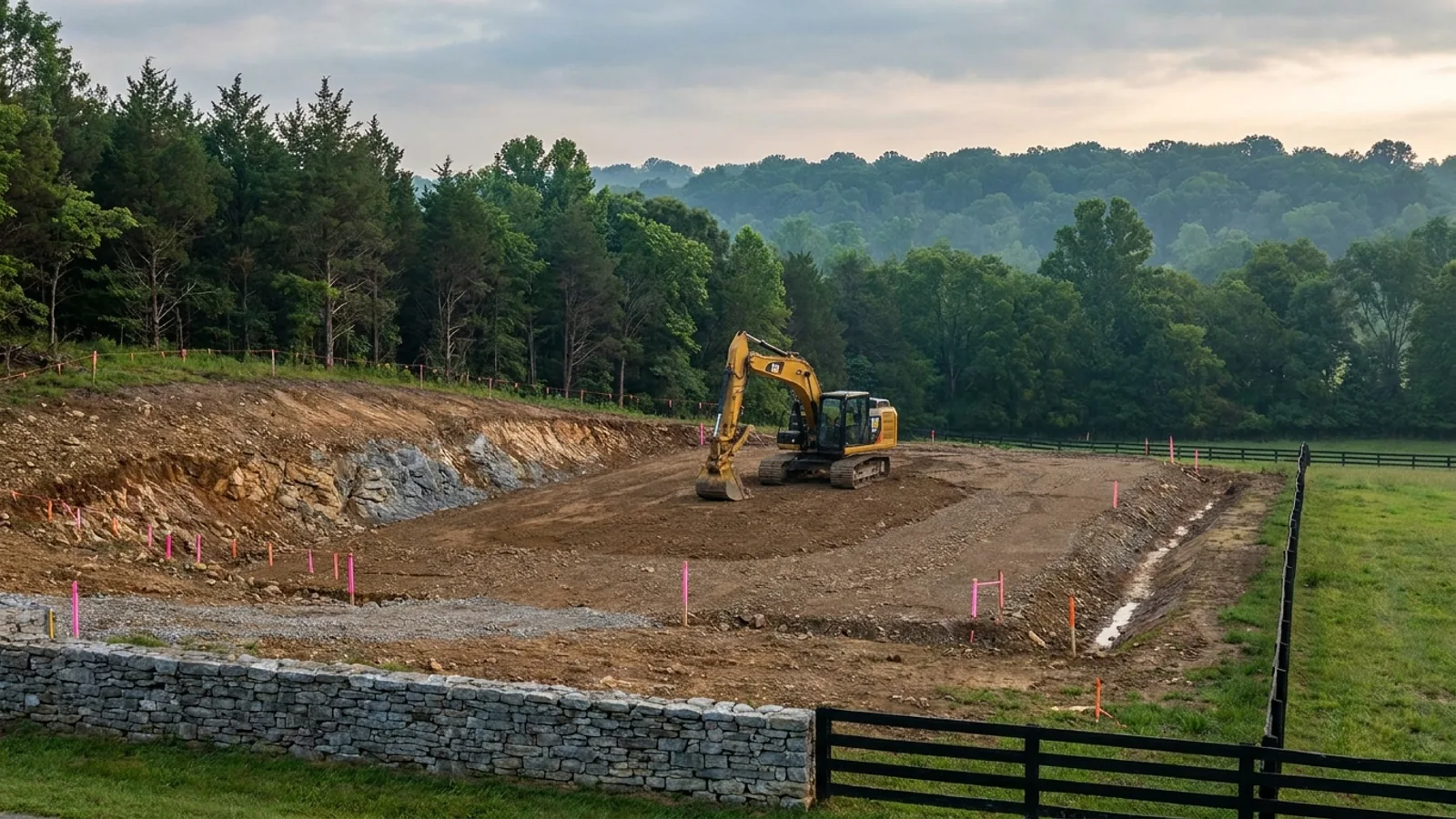
The expensive surprises are in the ground, not the building
What moves a Tennessee budget is usually below grade: limestone sitting shallow, karst voids and sinkholes, and slope. Those are the same conditions that decide whether a septic field passes its soil and site evaluation, so the grading plan, the footing depth and the drainfield get resolved together rather than one at a time. We price the dirt before we price the building.
What we build in Williamson County
All nine services are available across Williamson County. What a build costs depends far more on the parcel than on square footage, so we price against your land rather than publishing a rate card.
Barndominium Kits
Engineered barndominium shell packages delivered to your Tennessee lot, stamped for the criteria your county adopted.
Turnkey Builds
Start to finish barndominium construction: we handle permits, slab, shell, and full interior finish.
Custom Plans
Barndominium floor plans drawn to your land, your family, and the residential code your county actually enforces.
Post-Frame Homes
Pole barn construction adapted into full residences, with wide clear spans and fast dry-in.
Steel Construction
Red-iron and light-gauge steel framing: no rot, no termites, engineered to your county’s adopted wind criteria.
Shouses
Shop and house in one building: workspace and living space under a single roof and a single permit.
Metal Homes
Full metal-clad residences: low maintenance envelopes specified to your Tennessee climate zone.
Site Preparation
Clearing, grading, pad, drainage, and utilities: the work that decides whether the build goes smoothly.
Permitting & Engineering
Sealed structural engineering and the permit that depends on it, from submittal through final inspection.
What a build looks like
Three stages every Williamson County project passes through, from a raw parcel to a finished home. Site work first, because that is where the budget is decided.
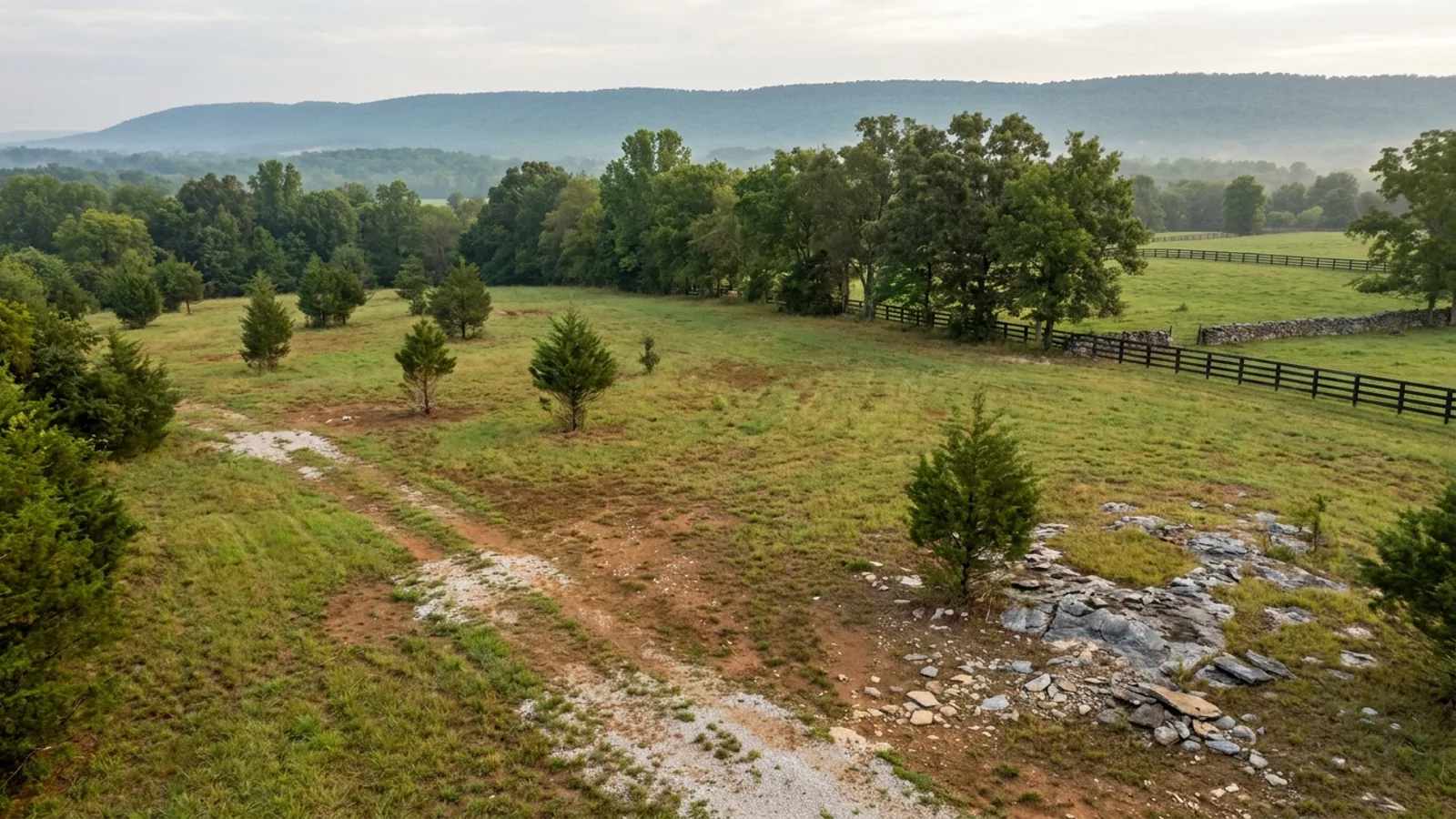
The parcel
Zoning, setbacks, flood zone and utility access get checked before anything is drawn.
Pad and permit
Clearing, grading and a compacted pad, while the submittal works through Williamson County.
Frame to finish
Shell erected and dried in, then systems, insulation and interior finish through to CO.
Those are the rules for Williamson County. Tell us what you want to build and we will draw it to them.
Where we build around Williamson County
Williamson County and the rural land around it. The buildable acreage for a project this size usually sits outside the city limits, which is frequently what changes who issues your permit.
Keep reading
The questions that usually come next once you know what Williamson County allows.
Barndominium Cost Guide
Sourced per-square-foot ranges by tier and by size, with a calculator built on the same figures.
Read itIs It Legal in Tennessee?
Classification, zoning, the HOA gate, and why "nonresidential farm building" does not cover a home.
Read itHow Long Does It Take?
Census build-duration data, and what actually sets the permit clock where you are building.
Read itSources for this page
The primary documents behind the Williamson County figures above. We would rather you checked them than took our word for it.
- Adopted CodesWilliamson enforces the 2021 IRC, ahead of the statewide minimum.williamsoncounty-tn.gov
- Building CodesThe county department, its inspections and contacts.williamsoncounty-tn.gov
- Building a HomeThe county’s own sequence for a new dwelling.williamsoncounty-tn.gov
- Sewage DisposalWilliamson runs its own septic programme, with fees banded by fixture load.williamsoncounty-tn.gov
- School Impact FeeThe fee that steps up by dwelling size.williamsoncounty-tn.gov
- Residential Jurisdictions & InspectorsThe State Fire Marshal’s own table of every Tennessee county and municipality, with its enforcement status. Stamped accurate as of 21 August 2026.tn.gov
Nearby areas we build in
Others we cover in this part of Tennessee. The permitting authority, the adopted design criteria and the zoning can all differ from one to the next.
Building in Williamson County: common questions
8 questions we get asked most often about building in Williamson County. If yours is not on the list, ask it directly.
Can I clad a house in metal in Williamson County?
Does the county permit my land, or does a city?
Which zoning district do I want, and how much land do I need?
Which building code applies here, and is it the same as the rest of Tennessee?
What design wind speed and seismic category should the engineer use?
Who handles the septic permit?
What will the county charge before I break ground?
Is my building exempt because it is agricultural?
What clients say
We had ten acres outside town and no idea what we could legally put on it. They pulled the zoning and the A-1 lot minimum before we spent anything on drawings, which saved us from buying plans for a building that would not have been approved.
Ordered the shell kit and erected it with my brother-in-law over about six weekends. The drawings were clear, the bolt schedule matched what showed up on the truck, and the county inspector had no issues with the engineering.
Turnkey from a cleared lot to certificate of occupancy. What I appreciated most was that when plan review came back with comments, I heard about it the same day along with what they were doing about it.
Building in Williamson County?
Start with the plan. Tell us what you want to build and we will draw it, then confirm what Williamson County will actually let you put on the parcel and what wind load it has to meet. That conversation costs nothing.