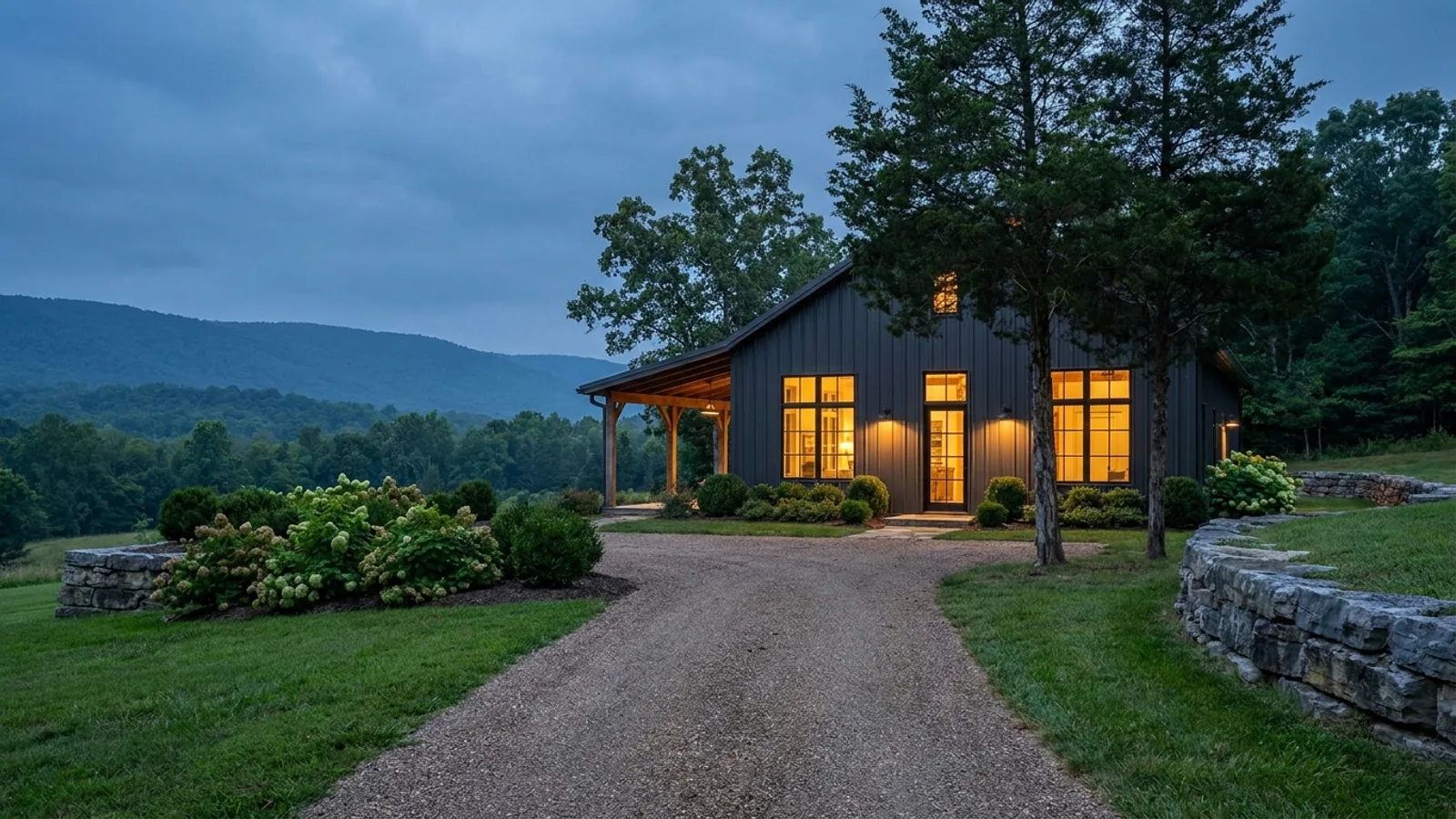
Barndominium Builders in Washington County, TN
This is Washington County in East Tennessee — county seat Jonesborough, Tennessee's oldest town, and largest city Johnson City, the anchor of the Tri-Cities. It is one of the very few Tennessee jurisdictions that answers the barndominium question in writing on its own website: barn-dominium style dwellings are allowed anywhere a single-family home is allowed, and stamped drawings from a design professional are required because the county classes them as an alternative construction method. The county enforces the 2018 International Residential Code itself, its own building inspector runs the footer-to-certificate-of-occupancy sequence in the unincorporated area, and its residential permit form has a checkbox for post-frame construction.
Washington County at a glance
- County
- Washington County
- Population
- 141,199
- ZIP codes
- 37601, 37604, 37614, 37615, 37659, 37656, 37681, 37690
- Site visits
- About 300 miles east of our Franklin office, in the Tri-Cities
Building conditions in Washington County
What actually changes from one Tennessee jurisdiction to the next: who issues the permit, whether the residential code is enforced there at all, what the structure has to be engineered to, and what the ground is like. These are the numbers your drawings have to satisfy.
Washington County, TN Zoning, Planning & Building Codes, Frequently Asked Questions, washingtoncountytn.org/377/Frequently-Asked-Questions, fetched 31 August 2026
washingtoncountytn.org/173/Codes-Compliance and the Washington County Building Permit Addendum revised 5 September 2024, DocumentCenter 2203, both fetched 31 August 2026
Washington County Residential Building Permit Application (8/2026), washingtoncountytn.org DocumentCenter 2880, fetched 31 August 2026
Johnson City, TN Design Criteria, Development Services Department Codes Division, 601 East Main Street, Johnson City, cms7files.revize.com Johnson City Design Criteria PDF, fetched 31 August 2026
Washington County Zoning Resolution Sections 601.1.4 and 601.2, washingtoncountytn.org DocumentCenter 2852, fetched 31 August 2026
Washington County Zoning Resolution Sections 622.1 to 622.3.3, washingtoncountytn.org DocumentCenter 2588 and the consolidated resolution DocumentCenter 2850, fetched 31 August 2026
Also worth knowing before you build in Washington County
- In R-1 the shop cannot outgrow the house
- R-1 Low Density Residential caps accessory buildings against the dwelling: "The total floor area of all accessory structures (total square footage) shall not exceed the area within the [principal] structure." A-1 and A-2 carry no equivalent cap, only setbacks — side or rear yard, 12 feet to any lot line. R-1 also requires the owner to sign a statement before the permit is issued affirming the structure is used for residential purposes only and not for commercial or industrial use or storage. On a shouse programme with a large detached workshop, the zoning district decides the build before anything else does.
- Three permitting authorities in one county
- Washington County's building programme reaches the unincorporated area only. Johnson City runs its own Building Division at 601 East Main Street, (423) 434-6047. Jonesborough, the county seat, runs its own. Watauga is a third municipality. Everything else — Gray, Boones Creek, Limestone, Telford, Fall Branch, Sulphur Springs, Embreeville, Washington College — is county jurisdiction, and the parcel viewer at gis.washingtoncountytn.org/zoningmap settles which side of the line a lot falls on.
- Septic runs through the state, not the county
- Washington County does not operate a septic programme under contract. Its own FAQ and its permit form both send applicants to the Tennessee Department of Environment and Conservation on (423) 854-5400, the Johnson City Environmental Field Office, for septic verification, permits and layouts. That matters to sequencing: the county requires the septic permit and the driveway permit in hand before it will issue the building permit, so on an unsewered parcel the soil and site evaluation is at the front of the critical path rather than a later step.
- How the permit actually runs
- Inspections must be scheduled by 3:00 p.m. the day before, on (423) 753-1753. One re-inspection is included at no charge; further re-inspections are $40 and must be paid before the next inspection can be booked. The permit becomes invalid if work has not started within 180 days, and expires if no inspection is requested for 180 days. Property corners must be marked and maintained for the term of construction, with the line strung or an as-built survey produced on request. Final inspection also covers driveway, seeding and drainage away from the building, and the owner stays responsible for reseeding until 70 percent growth coverage is reached.
- Climate zone 4A, on a 2009-era energy table
- Washington County is IECC climate zone 4A under Table N1101.7 of the Tennessee Residential Code 2018. Only twelve Tennessee counties sit in 3A and all of them are in the west of the state. The Tennessee amendments matter as much as the zone: the state replaced Tables N1102.1.2 and N1102.1.4 with the 2009 IRC tables and made duct testing under N1103.3.3 and N1103.3.4 optional, so a 4A envelope specified from a national article is usually specified tighter than Tennessee requires.
- Which Washington County this is
- Tennessee's oldest county, established 1777 while the territory was still part of North Carolina, with Jonesborough — founded 1779, Tennessee's oldest town — as its seat. 326 square miles of land carrying about 141,000 people, which is roughly 410 to the square mile and unusually dense for East Tennessee, so large acreage close to Johnson City is scarce. Buffalo Mountain rises to 3,520 feet at Pinnacle Knob on the eastern boundary. Washington County, Virginia, seat Abingdon, borders Sullivan County immediately to the north, and Bristol straddles the state line between them.
Washington County Zoning Resolution Sections 604.1.1, 604.1.4 and 604.3, DocumentCenter 2853, and Section 601.1.14, DocumentCenter 2852, fetched 31 August 2026
washingtoncountytn.org/172/Zoning-Planning-Building-Codes and johnsoncitytn.org Building Division contact details, fetched 31 August 2026
washingtoncountytn.org/377/Frequently-Asked-Questions, the Washington County Residential Building Permit Application, and tn.gov/environment/contacts.html, all fetched 31 August 2026
Washington County Building Permit Addendum revised 5 September 2024, DocumentCenter 2203, and the Residential Building Permit Application, DocumentCenter 2880, fetched 31 August 2026
Tennessee Residential Code 2018, Table N1101.7, up.codes Tennessee IRC 2018 Chapter 11; Tenn. Comp. R. & Regs. 0780-02-23-.02, fetched 31 August 2026
US Census Bureau 2020 census and 2025 county estimate via Wikipedia, Washington County, Tennessee and Jonesborough, Tennessee; Washington County, Virginia adjacency per the same source, fetched 31 August 2026
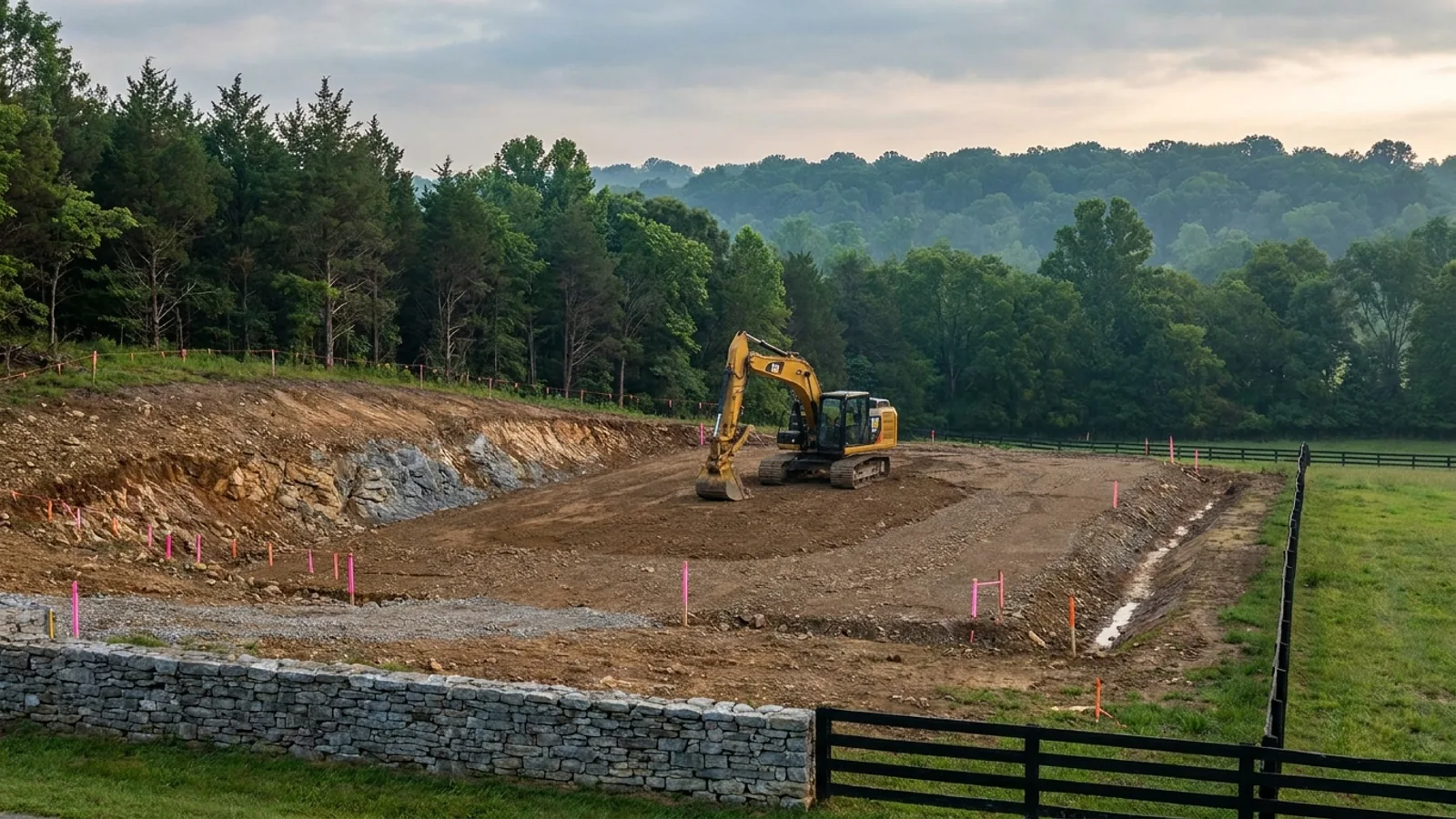
The expensive surprises are in the ground, not the building
What moves a Tennessee budget is usually below grade: limestone sitting shallow, karst voids and sinkholes, and slope. Those are the same conditions that decide whether a septic field passes its soil and site evaluation, so the grading plan, the footing depth and the drainfield get resolved together rather than one at a time. We price the dirt before we price the building.
What we build in Washington County
All nine services are available across Washington County. What a build costs depends far more on the parcel than on square footage, so we price against your land rather than publishing a rate card.
Barndominium Kits
Engineered barndominium shell packages delivered to your Tennessee lot, stamped for the criteria your county adopted.
Turnkey Builds
Start to finish barndominium construction: we handle permits, slab, shell, and full interior finish.
Custom Plans
Barndominium floor plans drawn to your land, your family, and the residential code your county actually enforces.
Post-Frame Homes
Pole barn construction adapted into full residences, with wide clear spans and fast dry-in.
Steel Construction
Red-iron and light-gauge steel framing: no rot, no termites, engineered to your county’s adopted wind criteria.
Shouses
Shop and house in one building: workspace and living space under a single roof and a single permit.
Metal Homes
Full metal-clad residences: low maintenance envelopes specified to your Tennessee climate zone.
Site Preparation
Clearing, grading, pad, drainage, and utilities: the work that decides whether the build goes smoothly.
Permitting & Engineering
Sealed structural engineering and the permit that depends on it, from submittal through final inspection.
What a build looks like
Three stages every Washington County project passes through, from a raw parcel to a finished home. Site work first, because that is where the budget is decided.
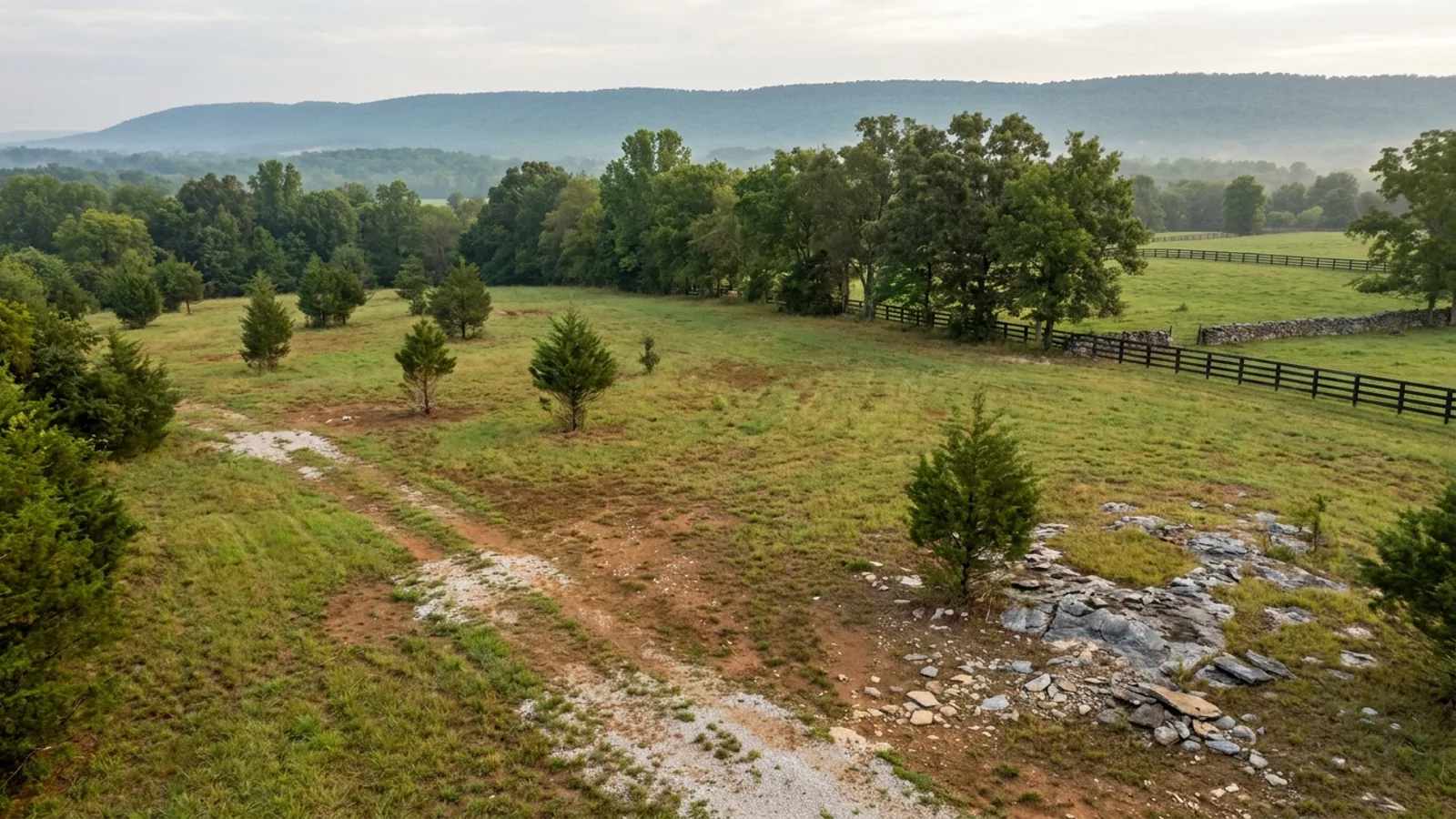
The parcel
Zoning, setbacks, flood zone and utility access get checked before anything is drawn.
Pad and permit
Clearing, grading and a compacted pad, while the submittal works through Washington County.
Frame to finish
Shell erected and dried in, then systems, insulation and interior finish through to CO.
Those are the rules for Washington County. Tell us what you want to build and we will draw it to them.
Where we build around Washington County
Washington County and the rural land around it. The buildable acreage for a project this size usually sits outside the city limits, which is frequently what changes who issues your permit.
Keep reading
The questions that usually come next once you know what Washington County allows.
Barndominium Cost Guide
Sourced per-square-foot ranges by tier and by size, with a calculator built on the same figures.
Read itIs It Legal in Tennessee?
Classification, zoning, the HOA gate, and why "nonresidential farm building" does not cover a home.
Read itHow Long Does It Take?
Census build-duration data, and what actually sets the permit clock where you are building.
Read itSources for this page
The primary documents behind the Washington County figures above. We would rather you checked them than took our word for it.
- Codes ComplianceThe county states it has adopted and is enforcing the 2018 IRC, and lists its inspections.washingtoncountytn.org
- Zoning, Planning & Building CodesThe department covering all three.washingtoncountytn.org
- Frequently Asked QuestionsWhere the county answers the barndominium question by name.washingtoncountytn.org
- Zoning ResolutionDistricts and lot area, which slide with utility availability.washingtoncountytn.org
- Zoning Office Fee SchedulePublished fees. Note the correct id is 374 — 253 serves budget resolutions.washingtoncountytn.org
- Residential Jurisdictions & InspectorsThe State Fire Marshal’s own table of every Tennessee county and municipality, with its enforcement status. Stamped accurate as of 21 August 2026.tn.gov
Nearby areas we build in
Others we cover in this part of Tennessee. The permitting authority, the adopted design criteria and the zoning can all differ from one to the next.
Building in Washington County: common questions
7 questions we get asked most often about building in Washington County. If yours is not on the list, ask it directly.
Are barndominiums allowed in Washington County, Tennessee?
Who issues the permit — the county, Johnson City or Jonesborough?
Does Washington County inspect, or does the state?
Can I put metal siding on a barndominium in Washington County?
How much land do I need, and is there a minimum house size?
What does the permit cost, and how does septic fit in?
Is this the Washington County near Bristol and the Virginia line?
What clients say
We had ten acres outside town and no idea what we could legally put on it. They pulled the zoning and the A-1 lot minimum before we spent anything on drawings, which saved us from buying plans for a building that would not have been approved.
Ordered the shell kit and erected it with my brother-in-law over about six weekends. The drawings were clear, the bolt schedule matched what showed up on the truck, and the county inspector had no issues with the engineering.
Turnkey from a cleared lot to certificate of occupancy. What I appreciated most was that when plan review came back with comments, I heard about it the same day along with what they were doing about it.
Building in Washington County?
Start with the plan. Tell us what you want to build and we will draw it, then confirm what Washington County will actually let you put on the parcel and what wind load it has to meet. That conversation costs nothing.